Guide · Baskets and portafilters
Why does my bottomless portafilter spray?
Spurts from a bottomless portafilter mean water found an easy path through the puck. The usual suspects, what to check first, and when the basket is to blame.
We may earn a commission if you buy through links on this page, at no extra cost to you. Unless a page says otherwise, our picks come from published specifications and listing research, not hands-on testing. How we make money · How we research
Short answer
Spraying means water has found an easy path through part of the puck, a channel, and is leaving that spot faster than the rest. The usual suspects are clumps or uneven grounds, a tilted or undersized tamp, a grind so fine that flow turns uneven, and a dose that does not suit the basket. Check them in that order. A bottomless portafilter does not cause the spray; it shows you what a spouted one hides.
What you are seeing
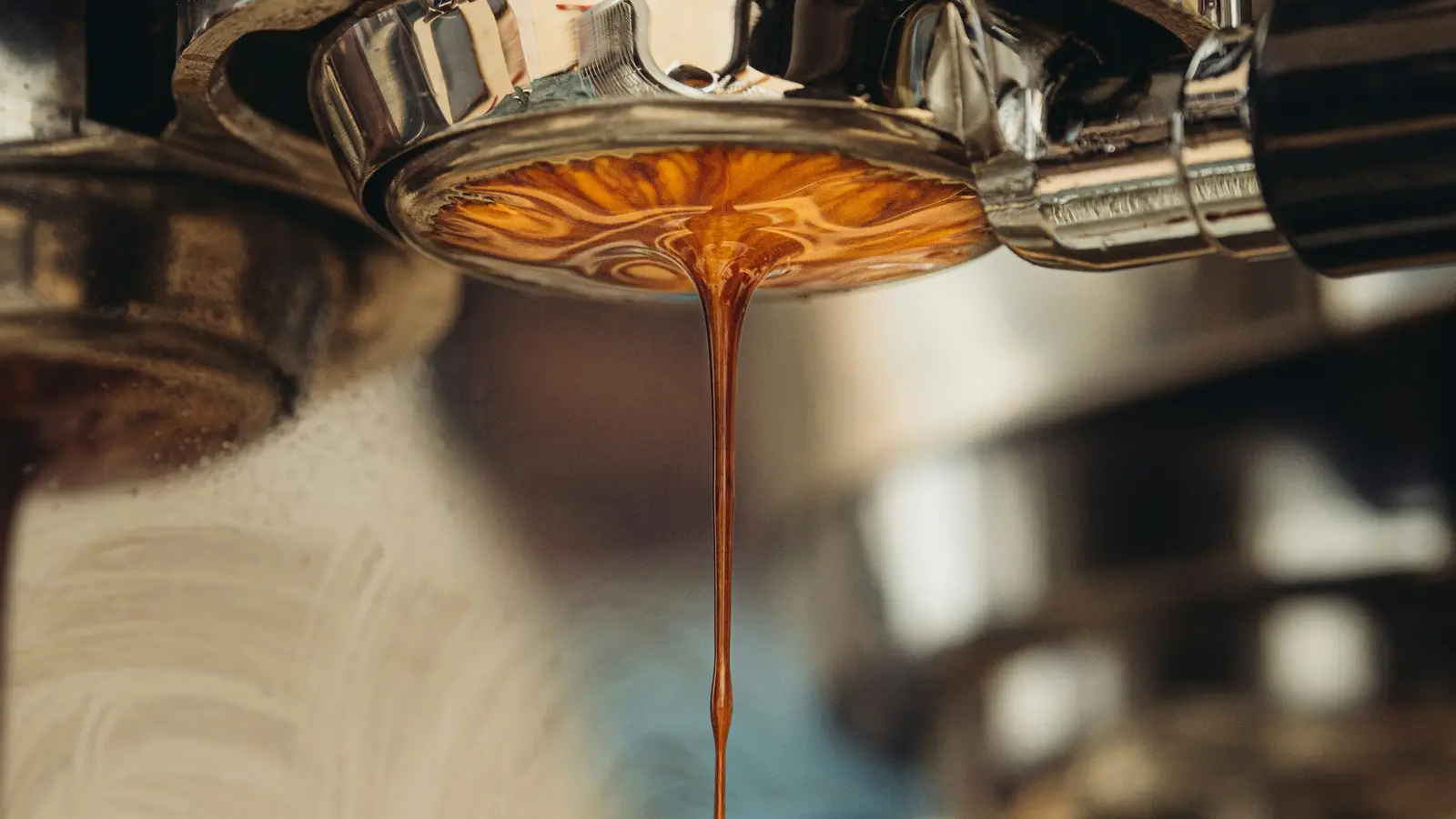
A bottomless portafilter has no spouts and no bottom, so you can watch espresso leave the underside of the basket. In a smooth shot, drops form across the basket and join into one stream. A spray is a fine jet from one spot. It means water is rushing through a weak point in the puck, a channel, while the rest of the coffee gets less water than it should.
The same channel forms in a spouted portafilter. You just cannot see it there. So a spray is a clue about your puck prep, not a fault in the portafilter.
We found no controlled study that ranks the causes of spraying. The order below follows the steps of puck prep and starts with the cheapest checks. Change one thing at a time so you know what fixed it.
1. Clumps and uneven grounds
Grounds often leave the grinder in small clumps and land unevenly in the basket. Loose pockets between clumps become easy paths for water.
Fix: stir the grounds with a needle tool before tamping, all the way to the bottom of the basket. Our guide to WDT shows how. Tamping harder is not a substitute: in Socratic Coffee's controlled test, tamps of 5, 10, 15 and 20 kg made no difference to extraction.[1]
2. A tilted or undersized tamp
A tilted tamp leaves one side of the puck thinner, and water favors the thin side. A tamper that is too small for the basket leaves a ring of loose coffee at the wall, which is a classic spot for edge spraying.
Fix: tamp straight down, and check that your tamper matches your basket. Precision tools for Breville's 54 mm baskets are about 53.3 mm, and IMS lists 53/53.4 mm for its Breville basket.[2][3] VST specifies 58.40 mm for its 58 mm-class baskets.[4] The basket and tamper size guide covers other machines.
3. A grind that is too fine
Finer is not always better. A peer-reviewed study found that extraction yield rises as the grind gets finer, then falls at very fine settings, because water starts flowing unevenly through the puck and shots become harder to reproduce.[5]
Fix: if shots spurt at a very fine setting, go slightly coarser and compare by taste and by the scale, not by how the stream looks alone.
4. A dose that does not suit the basket
Baskets are made for a range of doses, and the range rises with basket height. IMS lists its 24.5 mm B70 basket for 16 to 18 g of dark roast up to 20 to 22.5 g of light roast, and its 28.5 mm version for 20 to 26 g.[6] Its 23.5 mm Breville-size basket is listed for 14 to 20 g depending on roast.[7]
Far outside the range, the puck may not behave as the basket maker intended. Too much coffee can press the puck against the shower screen; very little leaves a thin bed.
Fix: weigh your dose and keep it inside your basket's range. To check headspace, dose and tamp as usual, lock the portafilter in without brewing, then remove it and look at the puck. A deep imprint of the shower screen or its screw means there is too little room.
5. A pressurized basket
Breville tells Barista Express owners to use single-wall baskets with freshly ground beans and dual-wall baskets with pre-ground coffee.[8] A dual-wall (pressurized) basket pushes the coffee out through a small exit in its outer wall, so the underside tells you little about the puck. If you want to read the flow, use a single-wall basket.
6. The basket itself
If one spot sprays shot after shot whatever you change, look at the basket. Hold it up to the light and check for blocked holes, dents or a bent wall. Coffee oils can clog holes over time; espresso detergent soaks are one way to clear them, and Urnex's instructions for Cafiza are 6 g per liter of hot water for 30 minutes, then rinse.[9]
Precision baskets are made to tighter tolerances: VST, for example, says it measures every hole on every basket.[4] Swapping in a different basket is a quick way to tell whether the old one is the problem. Our guide to precision baskets explains what the specs mean.
Is a little spray a problem?
Judge the cup, not the look. We found no study linking the amount of visible spray to taste, so treat a spurt as a clue to investigate, not a verdict on the shot. If the shot tastes balanced and your numbers are steady, a few drops off to the side are not worth chasing.
Next
Questions
Does a bottomless portafilter make espresso taste better?
We found no evidence that it improves flavor by itself. Its main use is showing you how the shot flows, which helps you find prep problems that a spouted portafilter hides.
Should I tamp harder to stop the spraying?
Probably not. In Socratic Coffee's controlled test, tamps from 5 to 20 kg gave no difference in extraction. A level tamp with a tamper that fills the basket matters more than force.[1]
Why does my shot spray only at the edge?
Common suspects are a tamper that is too small for the basket, which leaves an untamped ring, or grounds that are loose near the wall. Check your tamper against the basket maker's size, then stir the edges during WDT.
Can a grind that is too fine cause spraying?
It can make flow uneven. Cameron et al. (2020) found that extraction yield peaks and then falls at very fine grind settings because water flows unevenly through the puck. If shots spurt at a very fine setting, try slightly coarser.[5]
Will an AliExpress bottomless portafilter fit my machine?
Only if it is made for your machine's locking ears, not just its diameter. See why a portafilter won't lock and bottomless portafilters by machine.